Showing posts with label Adventurer. Show all posts

Thursday, 28 December 2023

Dungeons and Dragons Adventurer Magazine, a Baker's Dozen

Last time I told you that I'd bought my last issue of Adventurer. However, I needed a new set of dice (a present for my son-in-law) and they had a copy in at the local newsagents. The cover price is close to that of a decent set of dice and I didn't have to wait for delivery.
So here we go, a bonus review.

Sage Advice
We have a second article on time. This discusses how different movement rates affect distance travelled and the differences between fast normal and slow travel.
Curses looks at a few of the ways that characters can become cursed. Given the wide variety of curses in the game, the effects of a curse are glossed over. Importantly it also addresses common ways of removing curses 

Character Creation
This issue introduces a new character, a Dragonborn Barbarian. Last issue we had an introduction to the dragonborn race (though no rules as such) this time we have the standard introductory page on the class and a page each for first and second level features. As is standard, any potential choices have been made for the pre-gen character.
Better Roleplay looks at adding quirks to your character and how different drives can influence how characters interact with the rest of the world. This is good advice, though as a DM I shudder at the thought of every player choosing an 'amusing' character quirk

Lore
We have a page on The Weave, which is where magic comes from in the Forgotten Realms setting and a page looking at the pantheon most commonly used in the Realms. This latter is intended to give players some choices for their characters to follow. It very nicely suggests how characters in a world with many different gods with different portfolios might interact with them.

Freebies
The dice are a nice silver and blue and come with their own dice bag. There are also character sheets for the barbarian at first and second level. As an extra bonus freebie there's a large sheet of card printed with a dungeon floor texture on one side and a plainer texture suitable for outdoor encounters on the other side. This is 21 squares by 25 squares, and is the same thick card as the map in issue two. This is an excellent addition to any DMs equipment, though actually using minis and floorplans has yet to be covered. Personally I'd recommend photocopies to allow a DM to cut out individual rooms or perhaps some form of laminated sheets for using whiteboard or dry erase markers.

Conclusion
This is certainly one of the better issues. The articles continue to gradually roll out the rules, and I've expressed my understanding of that necessity and my frustration already.  That said, there are some good points, such as a character's relationship with multiple gods.
The encounter is another very good one too, more details below.
The extras really make this issue. I'd looked on both Fauxhammer, to see what the freebies were and Hachette's website to try and work out what the articles and encounter were likely to be. None of that mentioned the dice bag or the floor plan.

Encounter Chasing Shadows
As hinted last issue, the party have left Phandalin behind them and are on their way to Neverwinter. 
This encounter gives them the opportunity to foil a nasty little scam which is well presented. Bonus points for suggesting that the villain should try to escape if found out, and there's even mention of including them in future adventures.
Definitely one of the better encounters, and another that I'm going to steal.

Saturday, 23 December 2023

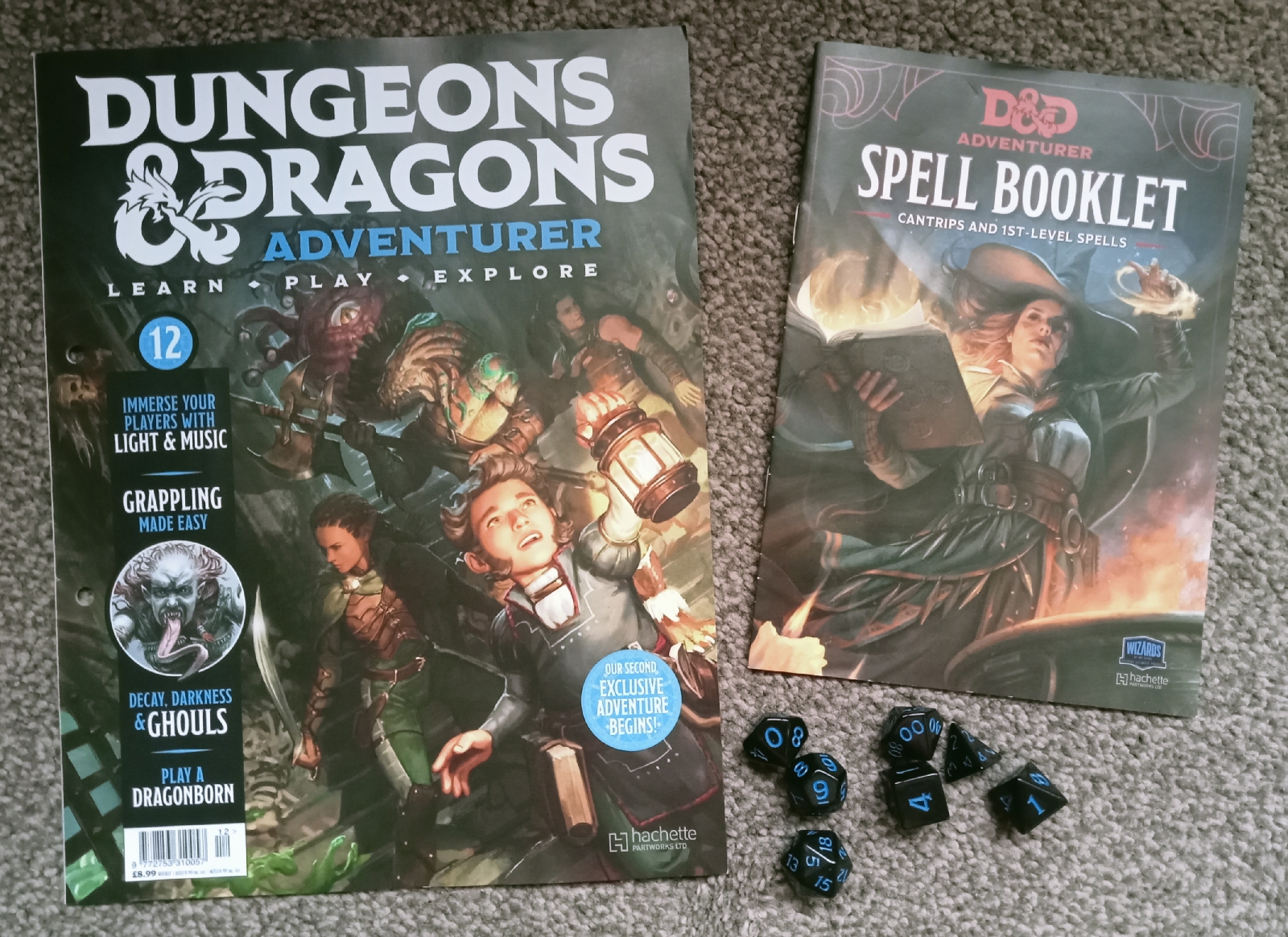
Dungeons and Dragons Adventurer Magazine Issue Twelve

Issue twelve marks the start of the second adventure. Apparently there will be seven adventures in total over the eighty issue run.  To mark the new adventure we have a new cover picture. Three of the original pre-gens (the dwarf cleric is missing) accompanied by a dragonborn are in an underground setting. Behind them lurks a beholder.

This is the last issue I intend to buy. I hope I've given the part-work a fair run to base my reviews on, and I wanted to see how the first adventure finished and what the difference was between the first and second adventure. I'll do a final post looking back on the first twelve issues, and perhaps even an extra post giving advice on running the first adventure.

Sage Advice
Sage Advice opens with an article on dice. Seriously, twelve issues in and we are just looking at the dice. If you've been collecting all the issues so far you have ten sets plus an extra d20. There are some suggestions on situations where certain dice are more likely to be used, but on the whole, a bit of a let down.
Then a DM guide to setting atmosphere at the table. Essentially this is a look at lighting, sound effects and music. There are some interesting points here, such as comparing film and video game music, and I'm delighted to discover that the BBC Sound Effects Library is now available online. 
I suggest you take the lighting advice with caution. At my age I need as good a light as possible, especially when reading character sheets and rulebooks. For me that's always going to be more important than setting a particular mood.
Finally a guide to grappling and shoving. This is useful, and I'll be using it for player reference. I do think that this should have been presented earlier though, perhaps in issue one's combat booklet?

Character Creation
Age first with a few suggestions how a character's age might affect their behaviour, and a table listing different species' lifespans and when they are considered adults. 
The Dragonborn article introduces the race as it appears in the Forgotten Realms. The next official pre-gen is going to be a dragonborn barbarian (next issue) so this is a bit of foundation laying.
The Life Domain is next, again a broad overview. Frustratingly it mentions that domains grant special abilities and access to certain spells, but these aren't actually covered.
The Folk Hero background gets a page, and we do get the associated rules as well as guidelines on how to play one.

Lore 
Ghouls get a page. As usual, this is just general history and a few suggestions on where they may be encountered and how they are likely to behave. No stat block, but you won't be surprised when you look at the end of this issue's Encounter.

Freebies
This issue we get another set of dice and a booklet of spells. This gives the rules for all the cantrips and first level spells relevant to the pre-gens. 
This is actually a great idea, though, of course, I'm going to suggest that it should have been included earlier. Presumably we will get more of these to cover other spell levels.

Conclusion
I found many of this issue's articles disappointing. I appreciate that the nature of part works means that there may be times when information needs to be imparted, but it might not be very interesting. Similarly, there are times when information can't be given early enough in the magazine's run, so it seems to come late (such as this issue's article on dice). However, I constantly feel that better page layout (and less artwork) would allow for more information to be presented on each page, allowing more to be covered each issue.
I'm not even sure that some of this issues articles are even needed.  The useful information on age could easily have been included on each race's pages (as it is in the Player's Handbook), and I feel that the dice article is long past being useful.

In terms of the Adventure, I'll address the Encounter below, but I will point out that there's no real difference between many of the Encounters in the first Adventure and the opening Encounter of the second (a basic escort quest). There's no sense of starting something new or different, though the PCs are moving away from the village at the end of the Encounter, heading towards Trentor.


Encounter; Plight of the Roaming Dead
The heroes are tasked with escorting an NPC. On the way they meet a pack of ghouls and have the opportunity to rescue more NPCs.
While there's nothing outstanding here, the Encounter is well constructed.  Once the Encounter is over, the party travels on to Trentor and the next Encounter, so the intention seems to be that they are leaving Phandolin.
The initial NPC is a relative of one the party already knows, so there's some continuity here, helping build relationships with the villagers (shame the PCs are leaving, but perhaps they will be back).

Sunday, 17 December 2023

Dungeons and Dragons Adventurer Magazine Issue Eleven

Issue eleven marks the end of the first Adventure and nearly the end of my review series. I plan to get issue twelve to see exactly what the transition to Adventure two is (different area? Level increase? New characters?) and also to get the Magic booklet, which hopefully will be as useful for my players as the combat one was (if a bit late).

Sage Advice
A look at temporary hit points and maximum hit points. 
Useful, as I've certainly known players who got confused over this.
Then articles on Treasure, discussing the many and various forms this can take, and Food and Drink. Although the latter article lists common inn prices there's nothing on cost of living.
Then the DM gets a couple of pages on Monsters. An overview of the different creature types and an explanation of how to read a stat block. 
Interestingly it mentions Challenge, which isn't included in the published stat blocks as the Encounters use milestone advancement.  It's nice that they are explaining how to read stat blocks, hope you didn't struggle too much for the first ten issues.

Character Creation
The only Character Creation page is another Background, the Acolyte. 
Once more filling in the stuff for the pre-gens.

Lore
A look at the city of Yartar and a page on Mummies. 
This is very general background stuff, no stats for the mummies.  I wonder what creature will feature in this issue's Encounter?

Freebies
another dice set and another dice tin.

Conclusion
More stuff on more stuff. I can't argue with the usefulness of it all, but I find myself constantly frustrated with the piecemeal nature of the role out. As an example, I previously knew nothing about the city of Yartar. I now know a bit about the leadership, the fact that the city is associated with piracy and a bit about five notable locations. It sounds interesting and suggests several adventure ideas. However, if I were running a Sword Coast campaign I'd want more, probably starting with a map of the city.
It's great to see more stuff aimed at the DM, but by now the DM's in the group have run eight or more Encounters, and should be able to read a stat block by now. Another example of pages that should have been included earlier in the run.


Encounter Cat's Cradle
Can the adventurers help out at an auction? They act as ushers during the sale and then guard the items overnight.
There are some issues with the Encounter, but I did enjoy it. It should be fun to run. The potential final encounter could be nasty for second level characters, but I bet the players will remember it for a long time.  The events leading up to it are all interesting and entertaining, and help foreshadow the main action.  All in all a superior Encounter.

That's the positives, now a few minor grumbles 
A better map of the location would be useful, as would a more in depth description (neither the map nor the introduction mention the skylights that play an important role in the adventure). Again I'm thinking that a website with downloadable content such as maps and handouts would really improve this series.  Would it cost a lot more to run?  I don't know, but it would certainly improve the usability of the magazine, especially if it included digital maps for virtual table-tops.
I do find Phandolin an odd place to hold such an important auction, and apparently the Miner's Exchange is now the closest place to a town hall in Phandolin, despite there being a mayor, as mentioned in the Queen of Scars Encounter.

Also, the Encounter goals states that the adventurers are to guard or steal the gem. If they do take it for themselves there's no indication of what the repercussions might be, though as this is the last Encounter in the first adventure, perhaps the second one begins with them avoiding justice? Given that Halia, the NPC running the auction, is a member of the Zhentarim, I would think that the adventurers might be facing repercussions if they take it. There is a lot of potential for spin off adventures (sorry, Encounters) here. My favourite idea is if at least one of the party is already affiliated to the Zhentarim. Their superiors might be impressed with the party's cunning and replace Halia with one of them.
It's not really the place of the magazine to cover in detail such fall out, but some hints would be good. Also there is no mention of the value of the Star of Khonsu (the value at auction, 2d10 x 100 GP, is laughably low for the effort put in by everyone involved) nor any magical properties it might have. They actually use a picture of the gem of brightness for the Star, but of course this could be simply reusing artwork (if you decide that the Star is a gem of brightness but don't want the characters to have immediate use of it, it does require command words to activate).

Dungeons and Dragons Adventurer Magazine Issue 10

Issue ten includes the final part of the Deadnock Mine Encounter. I really liked the first half, so I'm excited to read further.

Sage Advice
The second part of the article on movement, this time it covers Crawling, Climbing and Swimming. Jumping, including calculating just how far a character can jump, and a bit on riding, both on a mount and in a vehicle.
NPCs offers useful advice for DMs 

Character Creation
The second part of the article on Equipment, looking at some of the more obscure items and some more ready made packs.
Two more backgrounds, the Sage and the Charlatan covering more of the Pre-gens backgrounds.

Lore
Another area, the Sword Mountains and another faction, the Order of the Gauntlet.

Dice
The dice set this issue issue is a set of small metal dice.  These are great, they a nice weight to them.  

Conclusion
We are getting more part two's of articles, which is useful. Careful examination shows that these are rules and guidelines that weren't really necessary for earlier Encounters, though not in every case (I'd suggest that the NPC article would be useful far earlier for example). 
I have to keep reminding myself that the rather scattergun approach will be ironed out as pages are put into their correct order in folders.
The dice are lovely, probably justifying the issue on their own.  On the other hand the Encounter is not my favourite (see below).


Encounter Deadnock Mine part two
Last issue we left the PCs about to enter the second half of the mine, possibly riding in mine carts. What is waiting further down the line?

There is a large central cavern and several smaller caves containing goblins. These are set up as combat encounters. The main encounter is with the goblins' leader, a Nilbog and his unwilling audience. If they aren't careful, the adventurers may end up participating, so to complete their quest they need to defeat him.
And that it. The main encounter is titled Feywild Grotto, but there is no mention of the strange temporal slip that the dwarves were victims of.  This is a shame, as at a rate of one day equals one month, even an hour in here will have some noticeable effect once the PCs leave the mine.

I found this to be an underwhelming encounter, partly because I felt the first part promised much. There are always going to be bits of published adventures that individual DMs feel could be better or that don't work for their world/players/themselves, but often this is simply due to different groups finding different fun. This time there were so many missed opportunities that I'm
One issue is the lack of space. With just three pages, or six sides, there's always going to be stuff that isn't covered, and improvising mid game is an important skill for any DM. However, the way this Encounter is presented is very wasteful of space. The first side is given over to a lovely picture of some adventurers in a cave. I think this is taken from an already published book as it doesn't feature the Pre-gens. There is a brief summary of part one, which I suppose might be useful if the DM missed issue nine, otherwise, once the pages are snuggled up in an Adventures folder all nicely in order, its irrelevant.
There's a nice bit of original artwork showing the adventurers in a mine cart, emphasising the potential fun there, (and indeed they can use the cart to bypass the first group of goblins on this level) then the rest of the rather dull adventure. 

The stats for the Nilbog take up one a half sides (details of the Nilbog's spells are included, and it's nice to have them ready for use). However, the picture of the creature takes up at least half a side, a smaller picture and slight layout changes could have condensed this to one side. 

Worse to come, the back side is a repeat of the Goblin stat block from the previous issue.  Several of the Encounters have referred back to earlier stat blocks, so its not as if this couldn't have been done here.

There are other issues, such as the lack of details on using the mine cart, how fast does it go?  How easy is it to stop or redirect it?  The Feywild Grotto is described as having glowing crystals, stalagmites and wooden platforms, yet none of these are shown on the map, again, requiring DM improvisation (not in itself a bad idea, but this is supposed to be teaching new DMs, and it's quite important to the running of the adventure).

In conclusion we have a disappointing Encounter that promised much but lacked the space to develop them properly, yet two and a half sides were wasted space. I'm baffled by this, as it makes a potentially great scenario much the poorer.

Sunday, 3 December 2023

Dungeons and Dragons Adventurer Issue 8

Sage Advice
This issue looks at Sizes, describing the different size classes in D&D and what effect they have in play. 
We get the second part of the series on spell effects, this time looking at cones, cylinders and lines.
Finally, mounted combat. Not, perhaps, that urgent for second level characters, but it is very relevant for the Encounter later this issue.

Character Creation
Alignment lists the nine (and a half, counting unaligned) alignments, along with the sort of behaviour associated with each one.
Then a section on Tools, explaining how proficiency in tools works in game and listing common tool sets found in Dungeons and Dragons. Tools includes musical instruments, and I've always found D&D's treatment of this hopeless. The prices especially are way out, but that's a problem with the game itself, not the magazine.
Finally the first Profession, Outlander, is detailed.

Lore
The City of Neverwinter is introduced and there is a section on The Lord's Alliance.

Freebies
More dice. I rather like this set and find the red and black design appealing. They are a little difficult to read in low light levels, and I've played in some pretty dingy games shops in the past. I guess I'll have to pack these and last issues glow in the dark dice as well.

Conclusions
Some useful stuff, though I feel that further guidance on actually playing different alignments would be very helpful.  We are seeing a gradual build up of the essential rules for D&D, but I find this 'drip feeding' to be slightly off-putting.
The Encounter really makes this issue worth while though, see below for more details (and spoilers).


Encounter - Fun At The Faire
The characters are invited to a fair held in their honour, giving them a chance to show off, and foil a dastardly plot.  There are four events that the characters can take part in. 
The final event is a tourney (hence the earlier article on mounted combat). The result of this has a significant impact on the politics of Neverwinter, though it's not clear how much that will reflected in future adventures.
Why do I really like this encounter? It gives chances for characters to shine out of combat, and there are more opportunities to mingle with villagers and outsiders. Each event is different (though I'm not convinced by the musical one, it reads as more poetry), and there is no problem if the PCs fail. 

Sunday, 12 November 2023

Dungeons and Dragons Adventurer Magazine Review Index

I've been reading through Hachette's D&D Adventurer part work and giving my opinions. To make things easier for readers I'm linking to all my individual reviews here.  I'll keep this page updated with links to all my reviews.  There has been a lot of interest in the magazine, especially from overseas.  As the run continues it is becoming increasingly difficult to find it in the shops.  Some newsagents are happy to reserve a copy, though experience with other part works has shown this to be unreliable.  
Hachette do take subscriptions, but they are only for UK addresses.

Just a few words; I'm an experienced D&D player and DM, and I'm not really the target audience (and I  already have plenty of dice), so if you are relatively new to the game you may have a very different opinion.

It's my intention to read through the first eleven issues, which covers the first Adventure, and should give a good idea of where the part work is heading.  

Full disclosure; I bought these myself (in conjunction with a friend to spread the cost).


Friday, 10 November 2023

Dungeons and Dragons Adventurer Issue 7

Yes, another week, another part work, though this was two weeks coming due to 'production issues '. Perhaps there was a shortage of glow worms for the dice?

Sage Advice
Sage advice completes the conditions started in issue 3? with Exhaustion, Grappled, Paralysed, Petrified and Stunned (once placed in a ring binder these will be adjacent pages), then a page looking at currency. There's a bit on different types of treasure along with a description of the different standard coins. 
I do like the sentence for each giving an idea of the sort of things one such coin will buy. 
Then a page introducing puzzles. Sample puzzles are given, along with ways to integrate them into an adventure. The importance of the DM being prepared for the players failing is mentioned. There are no mechanics for puzzles given, perhaps in future issues? 
Puzzles are a divisive issue in D&D. There is an argument that puzzles properly only test the players, not their characters, relying on the players to work out the answer from their own knowledge. Conversely, the solution can simply require one or a series of successful dice rolls, player skill has no bearing, except, perhaps, in choice of skills.
The final Sage Advice page looks at Actions and Bonus Actions, including a list of possible Actions in combat. There was a similar list in issue one in the combat booklet.

Character Creation
Character creation looks at weapons and armour over two pages. Complete lists are given, along with the definitions of the keywords. 
At last, the heroes have something to spend their treasure on.
Finally, an introduction to gnomes, as we are getting a new pre generated character soon - every DM's favourite, the gnome bard.

Lore
This issue has no lore section.

Conclusion
I found this issue a little underwhelming. Completing the conditions, for instance, or a full two sides on coins and currency.  Both these articles contain something of use, but nothing I felt really exciting.
This is an issue that the format emphasises.  There are some parts of the rules that may be important for play, but are pretty mundane.  Important, but not exciting,  they do need to be included.

The puzzles articles is it's saving grace, though as I mentioned above, including puzzles in an adventure is very much a matter of personal taste (This short video addresses the issue rather well I feel).
A quick check on Amazon shows that equivalent dice are £7.59 for a set, so I suppose the cover price is still worth it.

If you want glow in the dark dice.


And finally...
Encounter - Graywind's Conundrum
This should have been excellent. A puzzle box that the players/characters have to solve. It ties into this issue's pages covering both gnomes and puzzles. There is a nice reward for solving it, but sadly the actual solving requires very little choice from the players.
They have to choose the correct order in which to do six tasks, but these tasks are simple Dexterity checks. There are consequences for failed checks, such as combats or effects applying conditions to the characters, but nothing to stop repeated attempts, other than a time limit for the whole exercise.  

The earlier article on puzzles discusses the use of props, and the encounter suggests that the DM show a picture of the cube to the players. However there is only one picture of it in the Encounter (there is a nice picture of a different cube on the first page, but that's an irrelevance) and it only shows two of the faces. It seems as if each Encounter gets one or two new pieces of artwork, I would suggest that an exploded diagram of the cube faces would have been far more useful here.

A couple more grumbles; it's another Encounter where the characters just happen upon an NPC who asks them for help. There's no extra information given on the NPC, though the assumption is that the PCs will be spending their treasure at her shop. A page or two for DMs on how to start adventures would be really useful (to be fair, it may yet be presented in the future), but the series seems happy sticking to the format of the rest of the Encounters with their 'you just happen across' hooks.
There's another example of wrong artwork here as well. One of the monsters has a half page illustration, but it's actually of a different monster. Both constructs, but not the same, and the picture is misleading as to it's capabilities.  If they couldn't find a picture of the actual creature that would have been another use for new artwork, though I'm pretty sure that earlier editions featured suitable illustrations.

This is an Encounter that works OK, but I had such hopes for it.  Since I have been so scathing, perhaps I should offer some suggestions for improving it?
Make your own version of the box.  You'll have to redesign the different faces, but that also allows you to remove references to wombats!  In essence, each face needs a different number of creatures, and those creatures should have some sort of tenuous link to the effect triggered if they are chosen out of sequence.  I'll leave you to decide what, as it may well depend upon the lore in your game (or real world folklore that you and your players are aware of).  I'd certainly keep the dragon and the six hound creatures.  Dormice might work instead of badgers, with a sleep effect.  In fact, different colour dragon heads with appropriate traps could work for some of the faces.

Monday, 23 October 2023

D&D Adventurer Magazine parts 5 & 6

I'm continuing to look through these.  It's now possible to work out roughly where they are heading and what they are covering by looking at the Hachette website.  They are starting a new Adventure in issue 12, so I'll probably finish with issue 11 (always assuming I can find them, they are getting thinner on the shelves - which is normal for partworks).


Both issue continue to develop all four of the sections, and I'm getting a better idea how these are put together now.  

Issue Five
Sage Advice covers the Three Pillars (exploration, social interaction and combat) in a very general way. A nice touch is suggestions for including aspects of one pillar within another. 
Then there are pages covering the different ways time passes in the game and how different light levels affect characters. 
Finally there's a section on damage resistance, vulnerability and immunity.
Character Creation covers the fighter class. As with the previous classes, there is a page of background and a page on first level features.
Lore covers the Neverwinter Wood. While it would have been nice to have details of potential wandering monsters, there is a very useful map of the region. This is the same area as the big map in issue two, but has the adventure locations from both Lost Mine and Icefire Peak marked, along with short paragraphs describing them. 
The second Monsters page looks at skeletons. No stats unfortunately, it looks like these will only ever be included in the Encounters.

The freebie in issue five is another set of dice, the third so far.

Issue six 
This issue is mostly concerned with levelling up. 
Sage Advice is a single page looking at magic items and discussing attunement. 
Character Creation is a large section, with an overview of levelling up and giving details of hit point increases. 
Then a page about Orcs as a character race followed by four pages detailing the new stuff the four classes covered so far gain at second level. If you're building up the collection in binders, these pages slot in after the relevant class sections covering first level abilities.
Lore continues the orc theme by looking at the Kingdom of Many Arrows.

Issue six also includes another dice tin and set of dice (two tins and four dice sets now, plus the bigger D20) and four more character sheets promoting the pre-gens to second level.

As previously, I'll look at the Encounters at the end, so you can avoid them if you don't want spoilers.

Summary
Honestly, for me the Encounters are the draw in the magazines. I've found useful stuff in nearly all of them. I will also be sharing the relevant class information pages with any new players in my campaign, though so far this covers only the options chosen for the pre-gens. 
It's interesting to see how the information is presented, and also how things have changed since fifth edition was first published. The inclusion of orcs as a player race so early in the run marks quite a shift. Previously, you had to wait until Volo's Guide to Monsters for this.  It emphasises the shift towards treating the different races as all essentially neutral, with certain individuals, perhaps, giving them a bad name.
The page on levelling up confirms that the Adventures use milestone XP, but does mention XP points as an alternative method.
The features at second level are designed specifically for the pre-gens. Whilst this is fine, and only what the starter sets do, I'd hoped that the collection would build up into a complete set of rules. There is a suggestion that other wizard schools will be covered in future ( the halfling has abduration), but there's no option for readers to make different choices. Of course, D&D Beyond is an option, though it isn't specifically mentioned here.
Given the total cost of the collection, I was hoping that more choices would have been covered.


The Encounters
The Crypt of the Elf Lord is almost brilliant.  It's another one I'm stealing for my campaign.  Briefly, the adventurers follow a lead from Carp Alderleaf, who, judging from his role as 'finder of concealed places' in The Lost Mine of Phandalin, must be a bit of a tear-away.  The crypt  is the last resting place of an Elven king and his crony's.  There is a trap, a puzzle, potentially a couple of combats and a nice treasure.  
However, the crypt is accessible for 'a few nights' only,  and characters can get trapped in it if they remain for more than eight hours.  The Encounter gives no method of escape, meaning a potential TPK. It's relatively easy to address this though, here are a few options that immediately occurred to me.
Extend the time limit and warn the players; Carp got trapped in the crypt for a day, only able to escape the following evening.  Thus he can both inform the characters of the location of the crypt, and warn them that it is likely to be difficult to get out (though he won't know that this is the last chance for a year).  The characters could even start the Encounter by looking for Carp after he fails to return home rather than the hook as given.
Foreshadow the danger; What if others managed to get into the crypt but fell afoul of the transitory nature of the entrance?  The remains of a couple of adventurers will show that there is some danger.  Maybe they are the ones who conveniently placed the silver coins in the goblet, but were unable to solve the rest of the puzzle.  One of them has a bundle of papers that note star constellations, especially Lavarandar's Lantern, with a mention of the dates it should be visible in the night sky.
Make another exit; If we assume that the crypt exists on both the material plane and the Feywild, presumably it should be possible to exit into the Feywild at other times.  The actual exit might only be present in the Material Plane, but the characters should be able to dig to freedom with appropriate Strength checks.

Queen of Scars has yet more orc action. It's an interesting Encounter, presenting a problem with several ways of solving it, though it's clearly intended that the problem be talked through rather than fought through. I'd have liked to have seen the titular Queen being a bit tougher, but that would make a violent solution much harder (its already very tough to fight to a win here). 
It's nice that the Encounters are demonstrating that there should be non-combat Encounters as part of a balanced Adventure, and although the writer discusses various ways of solving the problem, this is not prescriptive.  There are also repercussions to the solution chosen, which should influence the way the characters are viewed in Phandalin going forward.


Saturday, 14 October 2023

Dungeons and Dragons Adventurer Issues 3&4

I've had the chance to read through the next couple of issues of Adventurer magazine. You can see my thoughts on issue one here and issue two here. 
This time I'll  give a briefer overview and try to share my thoughts as to the suitability, or not, of the part-work.
As I've done previously, I'll cover the adventures at the end, so you can avoid spoilers.

Both issues use the familiar artwork with different spot colour. I wonder if they'll change this when we get to the second adventure?
Sage advice covers Conditions and Spell casting times and range.
We're starting to get more detail on spellcasting now, useful as the Character Creation sections look at clerics and wizards.
Character Creation covers Skills, Elves, Halflings and Dwarves, so we have general information for all the pre-gens races. There are introductions to wizards and clerics, much like the rogue stuff in issue two. 
As with rogues last time, a page of rough background before we start to look at actual class details and features.
Lore gives an overview of the Sword Coast and the start of two new sub sections; Factions, introducing the Red Wizards of Thay and the Zhentarim, and Monsters, looking at Vampires.
Unsurprisingly, they are filling in the Forgotten Realms world here.  Given the importance of Phandalin in the first adventure (or series of Encounters) I'd have liked to see more on that region, the town especially.  I should note that the Encounters (see below - or not if you even intend to play in them) use information from the Lore section as background.

The 'Freebies'
Issue three includes 'flats' of the four pre-gens. These are very nice, sturdy and clearly printed.  
As I said previously, if these had been around when I started playing D&D I'd have been building up a collection, but by now I'm too much of a minis addict to quite now.  I have, in fact, used card 'flats' before.  For adventures where I couldn't find anything quite matching the monster I was looking for, or for large numbers of minion types.  One Monk is a great source (among others) of these.
Issue four includes a big d20 and a pouch to hold it in. While not essential, it's nice to have. I keep mine ready for secret rolls when I'm running online games. 
The cheapest big die I could find on Amazon was around £8, so I guess this pretty much covers the cost of the magazine?

Summary
The part-work is starting to build up some useful information, but there's still a long way to go before it's even close to products such as the Starter Set or the Essentials Set.  There's a nice match up with the lore and the adventures, both encounters feature factions covered in the new Lore sections.
There are several examples of incomplete information. For example, two of the conditions are missing, though they are mentioned as being covered later. I appreciate that space is an issue, but I feel there are plenty of instances of inessential artwork which could have been omitted or reduced in size to give more room for text. Rather than keep all the definitions together, they will be spread throughout the part work.
On a related note, the DMs Tips are generally very useful, but the presentation is space wasteful. 

If you want more information about where the magazine is heading, check Fauxhammer's articles which mostly cover the freebies (mostly dice sets apparently), and Hachette's website, which gives a brief rundown of the contents of the next few issues.  This last is very useful for working out how the series is likely to progress, for instance, they will be levelling up the pre-gens, and introducing a new one, a gnome bard, all before issue 10.

And finally, the Encounters
The magazine refers to each issues six sides of Adventure content as an Encounter, but they often cover multiple locations with different groups of creatures. They remind me in scale of some of the encounters in the Essentials set adventure Dragon of Icefire Peak. I suppose Encounter has now replaced what I would call a scenario.

The Tower of Iron Will is billed as a mystery. There is a necessary combat, but the players will have to work out what has happened in the tower in order to succeed. I really like the concept and I'm certainly stealing this, with some changes, for my campaign.
Unfortunately, there are some issues with the clues, and there are aspects of the mystery that didn't, to me, quite make sense. It won't take much to knock it into a workable scenario though, especially by giving more options and reducing the linearity. There's also another mistake in the map numbering, but reading the text should make this obvious.

Daylight Robbery is more an extended encounter, though with the potential for expansion to something a bit meatier. Unlike the Tower, I found it very linear. There are few meaningful choices for the players (apart, perhaps from the 'open the box or take the money' choice). It also features an ambush, which I'm not keen on, but that's just a personal opinion.

Both 'Encounters' use milestone XP, or I assume they do, as there is no mention of XP. I believe that the pre-gens will level up to second level by about issue seven. As an exercise I tried calculating the XP available. Issue 1 gives 155, issue 2 gives 240XP, issue 3 gives 1300XP.  Issue 4 is hard to calculate, as the Boss Monster is a lower level variant of a D&D classic, so I'm not sure, though I'd guess she's about Challenge 3 or 4?
This is assuming no additional XP granted for completing a mission, though monetary rewards are given. By my reckoning the characters are second level by the end of issue three. However, this would require more information for both players and DM to handle, which won't be available for some weeks yet. 

The adventurers will also have amassed some treasure by now, but the only thing given a price so far is copying spells into spell books, and the Encounters haven't yet included any extra spells for this purpose. It would be trivially easy to include Shezayda's spell book in the Tower of Iron Will.

I do like the adventures. They are more than just a series of combats, and, as such, are a good guide to new DMs designing their own encounters. I would like to see more background and detail of Phandalin to help the players become more involved with the town and it's inhabitants. Four NPCs from the town have been mentioned, but with little more than a name and gender. Again, space issues may be the reason, but see my comments above.  My main complaints are lack of detail, though again, encouraging the DM to improvise is great, although few actual guidelines have been given, and the linear nature of some of the Encounters.

Thursday, 28 September 2023

Dungeons and Dragons Adventurer Issue Two

I picked up a copy of Adventurer magazine issue two. Here are my thoughts.

The pack includes another set of dice, a large poster map and the magazine.

The magazine
Another twelve loose leaf pages (24 sides). Again, the first page is cover and contents and uses the same artwork as issue one, but with gold spot colour rather than red.

Sage Advice covers advantage, disadvantage and inspiration, and short and long rests and hit dice. 
Useful stuff, and pretty much complete for the topics.  I think that the description of long rests uses the same text as the PHB.  This can (and has) cause confusion regarding what disrupts a long rest.

Then come two pages introducing Spellcasting, covering the basics of spells (spell slots, duration, components etc). Concentration is covered, as is how clerics and wizards prepare spells
There's enough information here for beginning spell casters to function. So far the only spells we have seen are on the pre-gen character sheets, though, of course, D&D Beyond has more information. 
I note there is a mistake in the examples given using the pre-gens.  The wizard is stated as having three spell slots rather than two.

Character Creation has a page on the human race species, then covers rogues, with a brief overview of the class, followed by a look at sneak attacks.
Presumably we will get the major PC species covered in a like manner, similarly the classes. The human page is general background stuff rather than any actual rules.
Given the amount of information required to run the different classes this is going to take some time to build up a full rulesbook's worth.

Lore gives a very general look at the Forgotten Realms.
This is the kind of thing I'd expected in issue one, but the encounter in that issue needed the Phandalin background.

The Adventure can be run using the pre-gens from issue one, still first level. As with my look at issue one, I'll put details in a section at the end to avoid spoilers.

I'm using words like 'overview' and 'introduction' a lot. The series so far seems a bit like reading the first couple of paragraphs of the relevant sections of the Players Handbook. 
I suppose this is inevitable. The format allows for later issues to fill in details, and there simply isn't enough space cover everything in one issue.  There are frequent mentions of D&D Beyond as a source of further information and choice.

The dice
The standard set of seven dice. This time gold flecked translucent. They look good and shiny, and I suspect that they are better quality than the cheap ones available on Wish. There's no tin this time. 
Another nice dice set. Still only one d6 though. I believe that dice bags are another 'freebie' later in the series. The dice sets are supposed to be colour coded to the adventures. I suspect they are front loading these so that all the players get a set early on.

The map
This is a hex map of the Sword Coast, the same area covered in both the Lost Mine of Phandelver and the Dragon of Icefire Peak. The map is large (76cm x 56cm) and glossy printed on card. The map has five mile hexes and has several adventure locations marked.
This is nice, though I have a couple of minor issues. I prefer six mile hexes (fits easily with adventurers' travel speeds and also with sight distances), but five miles seems to be the current WotC standard. 
If the map is intended as a play aid it does give away future adventure locations ahead of time. I know my players would immediately want to explore everything. Worse, this issues' encounter is further away from Phandalin than another site marked on the map.
It does allow us to know a bit more about Adventure one as a whole, though, which is interesting. In my deeper delve into issue one I suggested that there might be some kind of floor plans in this issue, well there isn't.  I guess they may have been too adventure specific?
A map of the town of Phandalin on the other side would have been very useful. Perhaps we'll get one later?

Thoughts
After the excitement of issue one, and the thrill of fighting rats, Adventurer is settling down to providing more rules.  Given that there are only eleven pages of content, including three of an adventure, that's not a lot of room, it looks like it'll be a few issues before the players have enough information to make truly informed decisions within the game.
I wonder if more small guides, like the combat one in the previous issue, might help. Magic would be a good start.
I do feel that DMs need more advice. So far the encounters do include hints and tips, but I think the way a game plays out at the table top needs more explanation.  This could be me speaking through 40+ years of playing, and there's a wealth of information out there (probably too much).
I'm sure that a group with one player who already has some knowledge of the game will do very well with Adventurer. As I said last time, there are cheaper and more complete ways for mixed groups of beginners and more experienced players to start. Perhaps a totally novice group will find this ideal.
Checking against the latest One D&D playtest document, I can confirm that the rules in Adventurer are essentially fifth edition.  WotC are claiming that One D&D will be compatible with fifth, so I suppose that Adventurer will still be useful once One D&D is published.


Finally, to avoid spoilers earlier...
The Forgotten Vault
This is listed as Adventure One, Encounter Two. It is a simple 'fetch quest', though nicely done. 
The heroes are hired by a Phandalin NPC to recover something from the titular vault. 
I like the reasoning behind why he needs help rather than doing this himself, though it's a magical effect that works automatically that I'm sure any wizard would want to learn.
There are a couple of potential combats, a trap and a hazard.  It's fairly straightforward, but I can imagine it would be a lot of fun at the table.
The six pages include a bit of DM advice, though less than last issue.  One page is a player handout, though it is printed on the back of a monster stat block, making it difficult to use in play, and it is a genuinely important handout containing some useful information and clues.  The stat blocks could have appeared on one page, with the monster pictures on the back of the handout.  I'd like to have seen this also available as a download.
Once again there is no mention of experience points, I guess that they are going for milestone experience.  Given the very structured nature of the product this is understandable (looking ahead on the Hachette website, one of the future issues deals with  levelling up.
I like this adventure, there is a lot more to it than King Under the Hill.  My main gripe is the set up. It is simply given as a quest with the assumption that the heroes will take it on.  Indeed its not even clear how the heroes find out about it.  There's no tie in to the previous encounter other than they both start in Phandolin.  There is the potential for some interaction with the quest giver, Daran Edermath, but its very much a case of you decide to do his quest so he gives you the map.  All these points are easy to fix, and below are my suggestions on how to do it.

Daran was one of the villagers captured by the cranium rats in King Under the Hill in issue one.  Impressed by the heroes efforts, he is looking through his old adventuring gear with a view to rewarding them. In doing so he finds the map and then contacts them.  
This makes the adventure much more personal, deepens the heroes' connection with an NPC, and rewards them for their previous adventure.
I'd also be tempted to allow the heroes to access the vault via the river.  It should be easy to alter Daran's map to hint at the river (indeed, it probably needs some extra text to indicate where the heroes should cross the Triboar Trail).  Clever players can then make the link between the river on the overground map and the one on the map of the vault.

I suspect that Adventure One is focused on the hidden elven kingdom of Iliyanbruen. There is brief mention of it in King Under the Hill, and one of the locations on the map is an elven crypt.


Monday, 25 September 2023

Dungeons & Dragons Adventurer Partwork - A Deeper Delve

I've had time to read through the first issue of Adventurer, so here's a more in depth review. I'll talk about the contents and add my thoughts, both about this issue and future issues, as far as can be determined. I'm trying to work out if it's worth getting more issues.  You might want to check out my initial look at the magazine here.
And a warning, there will be some spoilers for the adventure, so I'll look at that right at the end.

The Magazine
The magazine consists of fourteen pages (28 sides) designed to be separated and placed in ring binders. This is the same system Hachette have used in their Games Workshop part works. The different sections and sub sections build up over the weeks, presumably to make up a complete set of rules, along with background for the Forgotten Realms and a series of adventures.
The first page is just the cover, with contents on the inside. The cover art is very good, showing four adventurers fighting a bunch of skeletons. 
The next four pages are Sage Advice, split between three pages of Overview, giving a bit of background and history of the game, the difference between DMs and Players, the scope of the game, the general structure of play and how to use the dice. There is then one page of sub section B, The DM, giving a brief idea of what the DM's role requires.
There's a surprising amount of information in here, the basic sequence of play for instance (DM describes the situation, players decide what their characters want to try to do, DM describes the outcome. Repeat).  I'm not sure it's necessarily presented in the best order, and I do have some issues with some of the information (they missed a great opportunity to describe the 'checklist' all DMs should go through - can it fail? If not just narrate success. Can it succeed? If not just narrate failure. In all other cases determine what character abilities are relevant). But suspect that newcomers will find this interesting/useful. 

Character Creation gives an overview of abilities, species,  background and class. We are introduced to the four pre-generated characters (Crantor Thranax, human rogue, Eirina Illoris, elf fighter, Reizagar Stormhelm, dwarf cleric and Merovich Farfoot, halfling wizard). 
Ability scores, modifiers and proficiency bonus are next, then Species, with a focus on those of the Pre-gens. Character class is next, with information tailored to the starting characters, and finally a page on equipment, with nice illustrations of some of the equipment packs.
Some useful stuff, indeed I've used the illustrations for my online group already.  The big omission here is a guide to creating your own characters, but there is mention that this will be dealt with in future issues, and if the idea is to get people playing as quickly as possible then pre-gens are the way to go.  There's also frequent mention of D&D Beyond throughout the magazine, so I guess they are providing a way for the curious to find out more.  

Lore gives a very brief introduction to Phandalin. 
A predictable choice, given it's importance in the old Lost Mine starter set, the Dragon of Icefire Peak set and the recent Shattered Obelisk book.  Still, it's always useful to have a well developed town as a home for adventurers, and Phandolin is great for that.

Finally there is a six page Encounter. It looks like the magazine will feature a series of Encounters that build into Adventures.  Each Adventure is colour coded, and has a matching set of dice!  I gather that the Adventures take a party from first level to fifth and I gather that the early Adventures at least are using milestone experience rather than awarding it for monsters killed and quests completed.
In case you are ever a player in this, I'll give more details in a separate section near the end of this post, so you can skip it to avoid too much prior knowledge.

The Dice Tin
A tin. With dice.

Seriously, it's a nice set of dice, black plastic with red numbers, and they come in a foam insert in a tin with the Adventurer logo on the lid. As I said previously, this justifies the purchase on it's own. Amazon have sets of dice that work out slightly cheaper, but consist of multiple sets of seven, and they come in a cloth bag rather than a tin.  The foam insert even means that your dice don't rattle, though you'll have to lose this if you want to add any more dice.
The only downside I can see is how to pick out your Adventurer dice tin out from everyone elses at the table top.

The Combat Guide
This booklet is half page size, and has staples designed to fit in a ring binder. It covers the combat sequence, lists most (though not all) common options, explains hit points, damage and death saving throws and gives an example using the pre-generated characters.
This is a useful booklet, and I plan on sharing it with my players.  Not every option is covered, Dodge, for example is missing, but both Help and Disengage, important to encourage players to do more than just stand there and swing at opponents, are covered.

The Character Sheets
There are four pre-generated characters, already introduced in the Character Generation section and illustrated on the cover.  The sheets are well designed and clear to read, though the text is perhaps a little small for aging eyes in places. 
While there are no surprises in the choice of human, elf, dwarf and halfling, or rogue, fighter, cleric and wizard, they are avoiding the stereotypes of halfling rogue and elf wizard.  
These are nice character sheets, and I hope we will get some blank ones. Mention is made of D&D Beyond again for more character sheets.  
I do struggle to read some of the smaller type though.

Extras
While the various flyers don't add to the collection, they do allow us to see some of what is in store in future issues.

Subscriber Bonus
Subscribers get a free issue, a dice tray, a DMs screen (with new artwork), a free binder (though you'll need to buy more if you collect the whole set) and a dice jail.
Subscribers get free postage, so if you are seriously collecting all, or even a lot of issues, it's probably worth doing, and the bonus items are generally useful.

Looking Ahead
Those flyers reveal that future issues will also have sections covering Spellcasting and Combat (the Combat Guide is, I suppose, the start of this?).  The Encounters build up into Adventures, the included Encounter is coded Adventure 1/Encounter 1, so presumably it continues in issue 2. 
Issue 2 also introduces Spellcasting, Advantage and Disadvantage and talks about running a rogue.  The Freebies are another set of seven dice, gold this time, and an adventure map, which I assume is some from of floor plans.
Issue 3 looks at conditions and skills and has an article about the Red Wizards of Thay.  The Freebie is a set of character minis for the pre-gens.  These aren't 3D minis in the sense I'm used to, but full colour flats printed on transparent plastic.  Wizkids, among others, have produced these in the past, and I imagine that if the magazine regularly includes these then a new DM will soon have a decent collection.
I believe that issue 4 has a giant d20, but I'm not 100% sure.  I can't work out anything else about further issues.

*EDIT* the Hachette website gives more detail on future magazine contents, though nothing about the 'freebies'.


The minis from issue 3

The 'Freebies'
If you're familiar with Hachette's Warhammer 40K/Age of Sigmar part works you'll be used to seeing a load of 'free' plastic and paint.  I suspect that most people are buying these for the minis, not the magazine, but I could be wrong.
When they previewed Adventurer back in January the plan was to include dice with each issue. They have revised that, and now will also include adventure maps (floorplans?) Inspiration tokens and miniatures. These last appear to be the plastic figure flats that WizKids have brought out, judging from the picture of issue three above.  Whilst I'd have liked to have seen proper 3D minis, I'm certainly not short of them, and if this means that they can afford to include a good collection for new players and DM's, then that's a good thing. They don't need painting either, and are much easier to store.

Thoughts
What do I think of this?  Production values are high.  The artwork is good, with some nice new pieces, particularly featuring the pre-gen party.  Some artwork is reused from earlier WotC publications, but is used intelligently.
The gradual build up of rules may work well, but personally I'd find continual mentions of stuff being covered in future issues off-putting.  However, I'm a keen D&D player/DM who already possesses lots of rule books and scenarios.  I've been playing for 45 years more or less, so it's difficult for me to imagine what someone starting out might need.  This leads me to an important question...

Who is it for?
Honestly, I'm not sure. I can see the appeal of Hachette's various GW part works to players of the games. They consistently provide minis worth more than the cover price, as well as a set of rules, background and modelling and painting guides.  
But Adventurer magazine isn't really about the extras. While it's nice to have several sets of dice, there is, apparently, a limit to how many are useful at the table. Adventure maps, if they are floor plans, will be very useful, and the minis will hopefully build up into a comprehensive collection for new DMs and players.  It's all about the magazine building up a complete set of rules, a guide to the Forgotten Realms and a series of adventures.
Cost wise at £1.99 for the first issue, £4.99 for the second issue and £8.99 thereafter for a projected 80 issue run, that's £708.20 for the set. That's quite a few WotC hardback books.  However, it's a cheap buy-in if you just want to try a few games, and the intention is that you can play from issue one onwards.  I'm not sure in practice how well this works, there are some things I'd expect, such as a short example of play, that are missing.  Even the example in the Combat Guide simply states what each character is doing rather giving the player's comments as they interact with the Encounter.
I would imagine that players who begin this way might be rather frustrated if a particular option isn't covered for many issues. I suspect that a lot of people will start with Adventurer and move to the books or a starter set, and never forget that the fifth edition basic rules are currently available for free on the WotC website.  The roll out of options is, of course, controlled by the release schedule. This may not be too much of a problem for the players, especially if they are unaware of the possibilities they may be missing. It's more problematic for a DM wanting to design their own adventures, so perhaps the idea is that every DM runs the included Encounters/Adventures and nothing else?
Even when the collection is complete I don't think it will read well, certainly not like a rulebook (though the WotC rulebooks are disorganised and often dry).  I remember collecting the old Games Workshop Strategy Battle Games in Middle Earth part-work in the early 2000s, and that had the same issue.  The bulk of the rules were covered in the earlier issues, but remembering where to find particular rules could take ages.  Adventurer mitigates this with the loose leaf  format.
Another problem is that of edition. 2024 marks the fiftieth anniversary of Dungeons and Dragons. WotC are in the process of revamping the rules. The current fifth edition is to be replaced by OneD&D. They are playtesting new rules and have made it clear that they are work in progress. There are signs of the Adventure rules following the playtest, for instance, OneD&D uses the term Species rather than 5E using Race, as does Adventurer.

Conclusion
I really want this to succeed.  It has the potential to bring a lot of new players into the game, and the wider field of roleplaying (it would be great if there were mention of other games' systems, but obviously that isn't going to happen).
I don't think many people will follow it through to the end of the run.  I'm sure this is normal for many part-works anyway.  
It's certainly not aimed at me as a long time player, and I wouldn't recommend it to friends unless they were a group with no previous experience or access to an existing group.  My personal recommendation would still be Lost Mine of Phandelver and the free basic rules document, especially if you have access to a player or DM with some experience to guide play along. 
Failing that, Adventurer may just be the thing, a gradual build up of rules so there's no overload of information at the start.


And finally, ignore this if you don't want mild spoilers.

The Encounter
This looks fun and should provide a good introduction to the game.
It actually contains several possible combats, along with non combat interaction with NPCs (and an extra NPC to add to the Phandolin roster for future adventures) and some interesting treasure.
The choice of opponents, Cranium Rats, is an interesting one, especially with regards to the BBEG in The Shattered Obelisk.  The location, the Stonehill Inn in Phandolin is great. Given how useful it can be in future adventures, a full colour floor plan would have been nice, but perhaps this is coming in a later issue? The description of rooms is sparse, the DM will need to improvise the details.  
There are frequent box outs of advice to the new DM. I suspect they will phase these out over time, giving more room for a more complex Encounter.
There are some niggling errors, such as the location of the cellar entrance and where the stairs lead to (conflicting information in the room descriptions and the general information though it is obvious from the maps).  I also wonder if there are sufficient instructions to a new DM on how to run an adventure, but I've been playing for so long that I find it hard to judge such things.

Wednesday, 13 September 2023

Dungeons and Dragons Adventurer Issue One - First Thoughts

I managed to find a copy of  Hachette's Adventurer magazine and here are my initial thoughts. 


Contents
The first issue pack contains a 14 page booklet covering a bit of background to Dungeons and Dragons, what the role Dungeon Master involves (interestingly they don't use the more modern term Dungeon Moderator), an introduction to players characters, a bit about the town of Phandalin of Lost Mine/Shattered Obelisk and Dragon of Icefire Peak fame, and a short 6 page Encounter/Adventure.
There is also a pad of four pre-generated characters, a small booklet running through combat and a tin containing a set of seven dice (d4, d6, d8, 2xd10 D12 & d20) in a foam insert. 
Additionally there are leaflets listing subscriber benefits and an overview of the series, which will come in useful for working out what future issues might contain.

A Closer Look 
This is a bold attempt to make Dungeons and Dragons accessible to people. Just as with Hachette's various Warhammer 40K and Age of Sigmar part works, the collector will end up with a comprehensive set of rules in loose leaf binders (one of these is one of the subscriber's extras). The rules are presented clearly, and in the likely order that you might need them. As with the previously mentioned part works, the loose leaf format allows them to build up different sections covering Sage Advice (background to the game, advice on playing etc ), Character Creation, Lore (predictably for the Forgotten Realms), DM's advice, Combat and Encounters (mini adventures).

The booklets are full colour throughout, and I think it's nearly all new artwork. Slightly disappointingly the map for the adventure is only black and white, but it is clear to read.

Final Thoughts
So is it worth it?  Well yes if you're a role-player.  £1.99 for a nice set of dice in a tin justifies the cost alone.  Good luck hunting this out.

However, is it worth buying future issues or even subscribing?  I'll do a deeper delve into the first issue, looking at what I think does and does not work in a future post and try and work out who this is aimed at.

The Stone Men - Empire of Dust and Undead vs Orcs Kings of War Battle

We finally managed to organise a day for Boðvoc and my son to play Kings of War.  As they both had around 1000 points of a variety of bony c...